

 Image 1 of 1
The Flower Attunement Tarot: Plants, Archetypes & the Art of Self-Reflection | Oct 29 6:30pm - 9pm
Do you love plants? Are you curious about Tarot but unsure where to begin, or interested in exploring Tarot beyond traditional card meanings?
What if Tarot could be more than a way of seeking answers, and instead become a tool for seeing ourselves, our experiences, and the world around us from a new perspective?
Join botanical educator and founder of Primrose Apothecary, Felicia Howe, for an introduction to the Flower Attunement Tarot, a unique system that brings together Tarot archetypes, plant wisdom, the four elements, numerology, and flower essences.
Designed for both Tarot beginners and experienced readers, this class offers an accessible approach to understanding the deeper language of Tarot without relying on memorized card meanings. Together, we’ll explore the Major and Minor Arcana, the four elemental suits, numerology, archetypal energies, and the relationships between cards. At the heart of the Flower Attunement system is the connection between Tarot and the natural world. Each archetype is paired with a botanical ally and flower essence, creating an opportunity to connect the symbolic wisdom of the cards with the grounding and contemplative qualities of plants.
Rather than using Tarot to predict the future, we’ll explore the cards as a visual language for self-observation, emotional awareness, mindfulness, and personal transformation.
The cards don’t tell us what will happen.
They invite us to see what is happening.
Through guided exercises and a Flower Attunement reading, participants will learn how to step outside of an immediate situation, recognize patterns, consider new perspectives, and connect with nature as a source of reflection and grounding.
Come curious, whether you’re completely new to Tarot or looking to deepen an existing practice. No previous Tarot experience is necessary.
The Flower Attunement Tarot is a unique botanical approach to Tarot that brings together the wisdom of plants, Tarot archetypes, the four elements, numerology, and flower essences as a framework for self-reflection and emotional awareness.
When we are deeply immersed in a situation, it can be difficult to see the larger picture. Tarot offers a way to step outside of our immediate perspective and become the observer, allowing us to consider a situation through archetype, symbolism, elemental energy, and the natural world. The cards don’t tell us what will happen. They invite us to see what is happening.
The Flower Attunement Approach
The Flower Attunement Tarot brings together three interconnected systems of symbolic wisdom:
The cards become a bridge between the inner and outer worlds.
Each Tarot archetype represents an aspect of the human experience—beginnings, endings, desire, conflict, grief, courage, uncertainty, transformation, attachment, freedom, love, loss, wisdom, and renewal.
Rather than simply memorizing card definitions, participants learn to observe the archetypal story unfolding within a reading.
Through the archetypes, we learn to slow down and observe.
Through the elements, we recognize different qualities of experience.
Through numerology, we explore cycles, progression, and patterns.
Through plant allies and flower essences, we create a tangible connection to the natural world.
The result is not simply an interpretation of a card. It is an opportunity to embody its wisdom.
What Makes This System Unique
The Flower Attunement Tarot reimagines the traditional 52-card playing card system and the Joker—known in Tarot as the Fool— through a synthesis of:
Floral imagery
Tarot archetypes
The four elements
Planetary influences
Numerology
Plant allies
Flower essences
Each card is connected to the healing presence and symbolic wisdom of a specific plant, creating a living dialogue between the archetypal world and the natural world.
The structure blends the familiar sequence of Ace through King with the archetypal energies of the Major Arcana. Knights are translated as Jacks, while the Major Arcana are woven through numerological correspondences.
The first ten cards embody traditional Minor Arcana energies, while the remaining cards reveal additional layers through their numerical and archetypal relationships.
This creates a system that is both familiar and entirely its own.
What Participants Will Learn
1. The Language of Tarot
We begin with the foundations of Tarot:
The Major Arcana
The Minor Arcana
The Fool’s Journey
The four suits
Numerology and cycles
The four elements: Earth, Air, Fire, and Water
Court cards and archetypal characters
Upright and reversed perspectives
How cards relate to one another
How to begin reading without relying on memorized definitions
The goal is to understand the story and archetype behind the cards, rather than simply memorize meanings.
2. Tarot as a Tool for Self-Observation
Participants will learn how Tarot can be used as a contemplative practice to:
Step outside of an immediate emotional perspective
Recognize patterns and recurring themes
Explore different perspectives within a situation
Develop greater self-awareness
Identify emotional responses and energetic patterns
Cultivate mindfulness and curiosity
Ask more meaningful questions
Tarot becomes a visual language for looking at our inner landscape from a little more distance.
3. The Four Elements
Earth, Air, Fire, and Water provide another layer of understanding.
Participants will explore how the elements correspond to different qualities of experience:
Earth — grounding, material life, stability, embodiment
Air — thought, communication, perspective, mental activity
Fire — creativity, action, desire, vitality, transformation
Water — emotion, intuition, relationships, receptivity
Learning to recognize these elemental qualities can help us understand where an experience may feel balanced—or where we may need greater grounding, movement, expression, or emotional awareness.
4. Plant Allies & Flower Essences
One of the most distinctive aspects of the Flower Attunement system is its relationship with plants.
Each archetypal energy is paired with a botanical ally and corresponding flower essence.
Participants will be introduced to the idea of working with plants not only as physical botanicals, but as symbolic and contemplative allies.
The flower essence becomes a ritual point of connection—a way of bringing the lesson of the card into everyday life through nature.
Rather than asking, “What does this card predict?” we can begin asking:
“What is this experience teaching me?”
“What quality am I being invited to cultivate?”
“What plant ally might help me connect with that quality?”
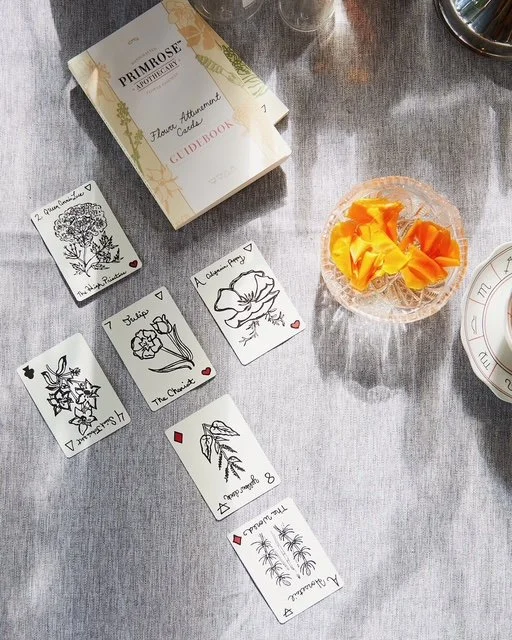
The Flower Attunement Tarot Deck - Each participant will receive their own deck to take home after the class.
The Flower Attunement Tarot is presented as a beautifully handcrafted botanical object.
The cards are 2½ × 3½ inches, the standard playing-card format, and feature original botanical imagery inspired by the natural world.
The accompanying packaging is designed in an 1800s-inspired letterpress aesthetic, giving the deck the feeling of an antique botanical artifact or apothecary object.
The artwork and presentation draw on historic printing traditions, including block printing and letterpress techniques, creating an alchemical connection between the contemporary practice and the botanical traditions of the past.
The result is both a divination tool and a tactile botanical art object.
Do you love plants? Are you curious about Tarot but unsure where to begin, or interested in exploring Tarot beyond traditional card meanings?
What if Tarot could be more than a way of seeking answers, and instead become a tool for seeing ourselves, our experiences, and the world around us from a new perspective?
Join botanical educator and founder of Primrose Apothecary, Felicia Howe, for an introduction to the Flower Attunement Tarot, a unique system that brings together Tarot archetypes, plant wisdom, the four elements, numerology, and flower essences.
Designed for both Tarot beginners and experienced readers, this class offers an accessible approach to understanding the deeper language of Tarot without relying on memorized card meanings. Together, we’ll explore the Major and Minor Arcana, the four elemental suits, numerology, archetypal energies, and the relationships between cards. At the heart of the Flower Attunement system is the connection between Tarot and the natural world. Each archetype is paired with a botanical ally and flower essence, creating an opportunity to connect the symbolic wisdom of the cards with the grounding and contemplative qualities of plants.
Rather than using Tarot to predict the future, we’ll explore the cards as a visual language for self-observation, emotional awareness, mindfulness, and personal transformation.
The cards don’t tell us what will happen.
They invite us to see what is happening.
Through guided exercises and a Flower Attunement reading, participants will learn how to step outside of an immediate situation, recognize patterns, consider new perspectives, and connect with nature as a source of reflection and grounding.
Come curious, whether you’re completely new to Tarot or looking to deepen an existing practice. No previous Tarot experience is necessary.
The Flower Attunement Tarot is a unique botanical approach to Tarot that brings together the wisdom of plants, Tarot archetypes, the four elements, numerology, and flower essences as a framework for self-reflection and emotional awareness.
When we are deeply immersed in a situation, it can be difficult to see the larger picture. Tarot offers a way to step outside of our immediate perspective and become the observer, allowing us to consider a situation through archetype, symbolism, elemental energy, and the natural world. The cards don’t tell us what will happen. They invite us to see what is happening.
The Flower Attunement Approach
The Flower Attunement Tarot brings together three interconnected systems of symbolic wisdom:
The cards become a bridge between the inner and outer worlds.
Each Tarot archetype represents an aspect of the human experience—beginnings, endings, desire, conflict, grief, courage, uncertainty, transformation, attachment, freedom, love, loss, wisdom, and renewal.
Rather than simply memorizing card definitions, participants learn to observe the archetypal story unfolding within a reading.
Through the archetypes, we learn to slow down and observe.
Through the elements, we recognize different qualities of experience.
Through numerology, we explore cycles, progression, and patterns.
Through plant allies and flower essences, we create a tangible connection to the natural world.
The result is not simply an interpretation of a card. It is an opportunity to embody its wisdom.
What Makes This System Unique
The Flower Attunement Tarot reimagines the traditional 52-card playing card system and the Joker—known in Tarot as the Fool— through a synthesis of:
Floral imagery
Tarot archetypes
The four elements
Planetary influences
Numerology
Plant allies
Flower essences
Each card is connected to the healing presence and symbolic wisdom of a specific plant, creating a living dialogue between the archetypal world and the natural world.
The structure blends the familiar sequence of Ace through King with the archetypal energies of the Major Arcana. Knights are translated as Jacks, while the Major Arcana are woven through numerological correspondences.
The first ten cards embody traditional Minor Arcana energies, while the remaining cards reveal additional layers through their numerical and archetypal relationships.
This creates a system that is both familiar and entirely its own.
What Participants Will Learn
1. The Language of Tarot
We begin with the foundations of Tarot:
The Major Arcana
The Minor Arcana
The Fool’s Journey
The four suits
Numerology and cycles
The four elements: Earth, Air, Fire, and Water
Court cards and archetypal characters
Upright and reversed perspectives
How cards relate to one another
How to begin reading without relying on memorized definitions
The goal is to understand the story and archetype behind the cards, rather than simply memorize meanings.
2. Tarot as a Tool for Self-Observation
Participants will learn how Tarot can be used as a contemplative practice to:
Step outside of an immediate emotional perspective
Recognize patterns and recurring themes
Explore different perspectives within a situation
Develop greater self-awareness
Identify emotional responses and energetic patterns
Cultivate mindfulness and curiosity
Ask more meaningful questions
Tarot becomes a visual language for looking at our inner landscape from a little more distance.
3. The Four Elements
Earth, Air, Fire, and Water provide another layer of understanding.
Participants will explore how the elements correspond to different qualities of experience:
Earth — grounding, material life, stability, embodiment
Air — thought, communication, perspective, mental activity
Fire — creativity, action, desire, vitality, transformation
Water — emotion, intuition, relationships, receptivity
Learning to recognize these elemental qualities can help us understand where an experience may feel balanced—or where we may need greater grounding, movement, expression, or emotional awareness.
4. Plant Allies & Flower Essences
One of the most distinctive aspects of the Flower Attunement system is its relationship with plants.
Each archetypal energy is paired with a botanical ally and corresponding flower essence.
Participants will be introduced to the idea of working with plants not only as physical botanicals, but as symbolic and contemplative allies.
The flower essence becomes a ritual point of connection—a way of bringing the lesson of the card into everyday life through nature.
Rather than asking, “What does this card predict?” we can begin asking:
“What is this experience teaching me?”
“What quality am I being invited to cultivate?”
“What plant ally might help me connect with that quality?”
The Flower Attunement Tarot Deck - Each participant will receive their own deck to take home after the class.
The Flower Attunement Tarot is presented as a beautifully handcrafted botanical object.
The cards are 2½ × 3½ inches, the standard playing-card format, and feature original botanical imagery inspired by the natural world.
The accompanying packaging is designed in an 1800s-inspired letterpress aesthetic, giving the deck the feeling of an antique botanical artifact or apothecary object.
The artwork and presentation draw on historic printing traditions, including block printing and letterpress techniques, creating an alchemical connection between the contemporary practice and the botanical traditions of the past.
The result is both a divination tool and a tactile botanical art object.